

Who is behind
The team
Founder
Working on climate change is above all about service and vocation.
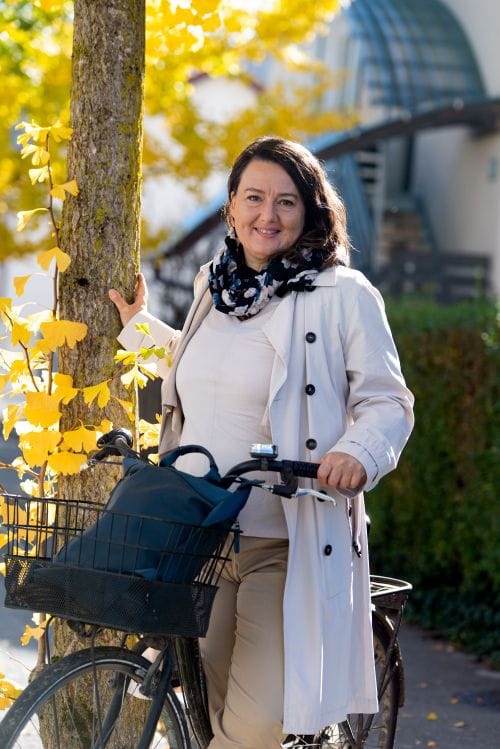
Barbara Simonič
She is the founder and director of the Institute for Climate Solutions since its establishment in February 2025. Before that, Barbara worked in the field of climate change within the state administration for more than 13 years and later within the international organization Climate KIC for two years, and half a year at the Institute for Risk and Crisis Research of the French Mines ParisTech. She completed her studies in international relations at the Faculty of Social Sciences (University of Ljubljana) and European Affairs at the College of Europe in Bruges, Belgium.
Some highlights from the CV:
I am the proud first woman head of the Black Ant Scout Association from Moste, Ljubljana during my student years (2003-2005). After six years of leading groups as a guide, in 2003 I completed a course for unit leaders at the Slovenian Scout Association and became the head of the group, leading preparations, winter and the summer camp. The Black Ant family has been active in Moste since 1952 and is one of the oldest scout groups in Slovenia. By learning to live in nature and among people using the scout method, it contributes to the implementation of the motto “with nature towards a better man”!
During my student years, I did many student jobs, from instruction, translation, organizing activities for children to working in the store and as a waitress. In this way, I also paid for a 14-day study trip to Egypt.
Later, I joined the student association, the only international association with headquarters in Slovenia at the time, the International Association of Political Science Students (IAPSS), as a member of the executive board, treasurer and later a member of the supervisory board. I led a project supported by the Council of Europe “Youth Bridging the Gap: Reaching Out to the Roma”, which included a one-week seminar in Slovenia.
My bachelor thesis entitled “Ethical and Practical Issues of Environmental Protection: An Attempt to Define the Field of Political Ecology” was nominated for the Prešeren Award.
In my final year of studies, I was selected for an honorary student work during Slovenia’s first presidency of the Council of the EU in the first half of 2008 as a liaison officer.
Before completing my studies, I obtained an EU scholarship from the Leonardo da Vinci program to complete a paid internship at a research institute in France (CRC). In Nice, I conducted a policy network analysis of actors with interviews with several key actors and prepared a report in French for the preparation of a tool for sustainable management of water resources and associated flood risks on the case of the Var River Valley.
While still completing my internship, I obtained a scholarship to study at the College of Europe, which obliged us participants from Slovenia to work in Slovenia for at least 3 years after completing our studies. Thus, in 2010, after completing my studies, I was employed at the then Government Office for Climate Change of the Republic of Slovenia (SVPS).
At the SVPS, I initially worked as an intern, and later, after shortening my internship, as a consultant, helping to prepare the long-term climate strategy and the Climate Change Act, participating in decision-making processes in the EU within the Climate Change Committee, was the editor-in-chief of the SVPS website and secretary of the Sustainable Development Council, and participated in European and other projects, such as providing trainings within the framework of the Environmentally Efficient State Administration program.
After the abolition of the SVPS, the field of climate change was taken over by the then-established Ministry of Agriculture and the Environment. The first year was demanding, as all previous programs had to be discontinued, and at the same time, European projects remained that were not easy to exit. I led the activities of European projects of three transnational programs ALPSTAR, LOCSEE, and CEC5, and for the first time in 2014, as a thank you for the work successfully done, I attended the Conference of the Parties to the UNFCCC – COP20 in Lima, Peru. The projects required the work of several people (7 FTE), who could not be employed due to employment restrictions in the state administration, so I did the work myself and saved more than 100 thousand euros and provided the budget with funds for climate measures. In the meantime, I participated in the preparation and implementation of strategic planning documents in the 2014-2020 financial perspective and was the secretary of the working group for the green tax reform in the period August-December 2012. I also prepared the First Annual Report on the Implementation of the Operational Programme of Measures to Reduce Greenhouse Gas Emissions by 2020 (OP TGP 2020), which was adopted in 2015 (the report referred to 2014). Even then, it was clear that transport was Slovenia’s biggest challenge in the field of climate change mitigation, as emissions were increasing and measures were not being implemented, so in my further work I focused on covering the field of transport and sustainable mobility. I also participated in the preparation of the first transport strategy and the first strategy for promoting the development of the alternative fuels market in Slovenia in 2016.
At the ministry, I also led the Quality Assurance Group for National Emission Inventories (QA/QC) for a while and the Expert Group for the EU 2015 and 2020 Reference Emission Scenario.
After the 2014 elections, the Ministry of the Environment and Spatial Planning (MESP) was re-established, where the Climate Change Department was placed. I was the initiator of the Green Working Group of the MESP, which prepared measures for the ministry. We also prepared an Environmental Statement for obtaining the EMAS label, but unfortunately the document was not approved. I also mentored a volunteer intern for the first time, and together we prepared the first documents in the field of climate change adaptation – the first analysis of the country’s vulnerability to climate change and the climate change adaptation strategy, which was approved in December 2016. This enabled the use of funds for climate change adaptation purposes in the amount of more than 350 million euros. I was the first National Adaptation Contact Point at the European Commission, a member of the Impacts and Vulnerability Group at the European Environment Agency, a member of the OECD Expert Group on Adaptation and later at the UNFCCC. Together we developed the first climate projections for Slovenia, and published them in the form of the Climate Projections Atlas. We persuaded other sectors to include climate projections in their work, e.g. in flood risk analysis, tourism planning, water management, forests and agriculture; often unfortunately unsuccessfully.
After the 2018 elections, I took over the stewardship of the Climate fund and prepared a program that doubled the use of funds (accumulated earmarked funds for climate action) from 40 million to 80 million in a year. I led a team of 10 people with whom we developed and implemented new measures and projects until the beginning of 2020, when I was relieved of these tasks in April 2020 due to disagreements with the new government. I kept some projects and contracts, as I was the steward of over 20 contracts, often multi-million ones. I also participated in the Climate Committee of the Alpine Convention, the Climate Mission Committee and other international activities. In August 2020, I enrolled in the doctoral study of Environmental Protection at the University of Ljubljana, as it seemed that the Covid period would last for some time.
I participated in the LIFE IP CARE4CLIMATE project and the Slovenian presidency in the second half of 2021, co-chaired the EU Adaptation Expert Group (WPIEI-CC) within the framework of COP26 in Glasgow. In 2022, I resigned from the ministry, despite being regularly promoted to the position of Undersecretary, because I did not see the point in re-drafting the Climate Law (which we have already drafted twice, and in the meantime the EU has adopted a directly applicable European Climate Law) and in not addressing the area of climate action in a systematic and ambitious way, where transport measures are particularly important. At the invitation of a colleague, I joined the team of the then EIT Climate-KIC (Knowledge and Innovation Community), the European Community of Knowledge and Innovation in the field of climate, supported by the European Institute of Innovation and Technology (EIT) on the project Deep Demonstration of a Circular, Regenerative and Low-Carbon Economy in Slovenia. I acquired and transferred knowledge about systems thinking and theory and methods of system innovation, which are key to addressing climate change. I was responsible for preparing the food portfolio of innovative measures and managing the financial architecture, which helped to promote change and mobilize resources, and led the stakeholder engagement for the mobility sector. I also participated in the preparation of solutions for the built environment, in the field of entrepreneurship, policy laboratory, and in project management.
In the meantime, I was invited to participate in the implementation of the Harmonmission project, as a member of the Advisory Groups for the Adaptation and Net Zero Cities Mission. Thus, from May 2024 to June 2026, I was part-time employed as a professional associate at DIH Slovenia (Digital Innovation Hub Slovenia).
After two years and the acquired knowledge and experience in the field of systemic innovation, I founded my own company, Klimalab (a company for innovative climate consulting and education), Barvita and the Institute for Climate Solutions, and set off on an independent journey. I also cooperate with the Ljubljana Cycling Network, namely coordinating the Bicycle Library project.

colleagues
Friends, colleagues and external contractors...
Ram Dušić Hren
Ram is the founder of Bright3r, a company that develops approaches for holistic solutions to complex social and environmental issues. He comes from a scientific and technological background – after a master’s degree in physics and research at the Jožef Stefan Institute, he focused on technological entrepreneurship, then joined IBM, and has been working in his current position since 2020.
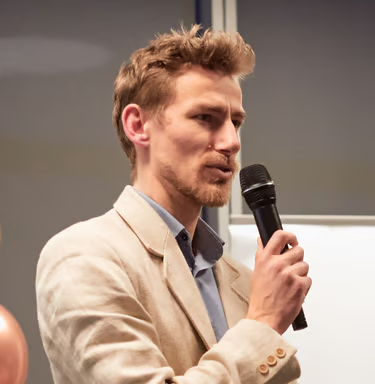

mag. Tanja Peršin
Tanja holds a university degree in political science and a master’s degree in information systems and decision-making. During her studies, she researched inequalities between people in the way they access information in the digital age. She developed her career in the waters of digital communications. For more than 15 years, she has been helping companies and other actors achieve their communication goals by planning effective and meaningful messages. She is a specialist in digital communication, advertising and social networks. She focuses on B2B communication – with the understanding that behind every business there are people.
mag. Borut Cetina
Borut holds a Master of Business Administration in Entrepreneurship and Marketing with experience in technical sales and marketing. Today, he is increasingly driven by his research nature, curiosity, desire for knowledge, and tireless adventurous spirit, which direct him towards developing strategic and creative solutions and collaborating in creative teams – both on an abstract and practical level.
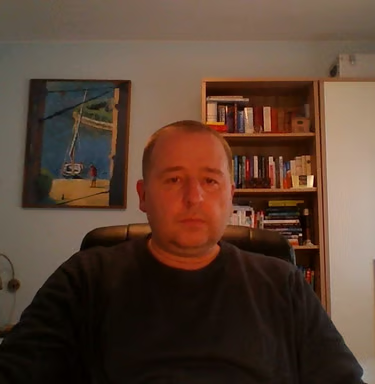

Ana Hafner, mag.
Ana holds a degree in philosophy and a master’s degree in sustainable development management. Her research focuses on ecological anxiety and questions concerning the relationship between humans, nature, and society. She works at the Institute of Ecology, where she is involved in political ecology and the social-science dimensions of sustainable development.
If you would like to participate in our activities, join us!
Our partners




 Donate